
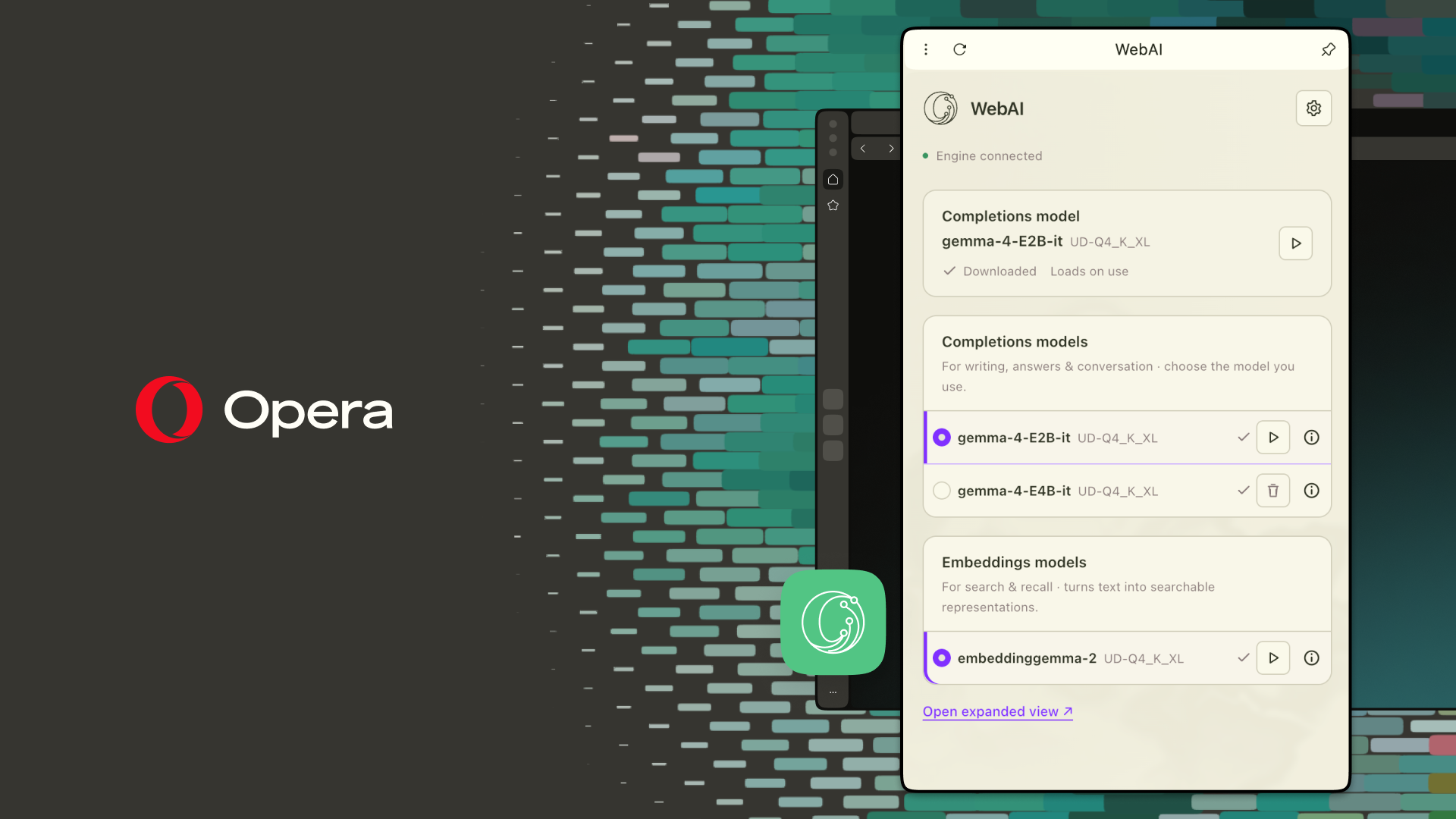
Now rolling out in early preview, WebAI marks the start of a bigger push into local AI. Also launching: HTML-in-Canvas, which puts live web pages inside 3D worlds.
OSLO, Norway – October 27, 2026 – Opera (NASDAQ: OPRA), a leading global browser and AI agent company, today began shipping local AI models in its browsers, making AI that runs on the user’s own computer a central part of the next generation of Opera browsers. The first capabilities are available today as an early preview in Opera One, with Opera GX and Opera Neon to follow.
With local AI built into the browser, both users and developers can benefit from new capabilities. Local AI lets anyone build on top of free, open-weight AI models. Developers can add AI features without running AI infrastructure or paying for every request. Users don’t need AI subscriptions, the information the local AI handles stays on their own device, and they stay in control of the AI on their computer. For example, an extension could sort your tabs, flag clickbait or spot relevant job posts using a model on your laptop, with no account, no fee and no data sent to an AI service.
As open weight models have become smaller and more capable, and everyday computers more powerful, local AI has become practical in the browser. Opera was the first major browser to offer built-in access to local AI models, in an experimental developer build in 2024. Today’s launch brings that work into everyday browsers.
“A lot of what people want from AI doesn’t need a data center. Your laptop can already do it, without sending your data anywhere,” said Krystian Kolondra, EVP Browsers and AI, Opera. “We first shipped local models to developers in 2024. Now we’re bringing them to everyone. More models and tools are coming, and you’ll always decide what runs on your machine.”
In this release: WebAI
WebAI is a proposed web standard, backed by companies such as Google and Microsoft, that lets websites and browser extensions use AI hosted through the browser. Opera’s implementation is model-agnostic and built around open models, offering users choice among AI providers. At launch, users can already tap into models from Google and Apple, including Google’s Gemma and, on Macs, Apple’s on-device foundation model, directly in Opera.
With WebAI, anyone can generate text, classify content and understand how pieces of information relate, all directly in the browser.
WebAI is opt-in. Nothing is downloaded until the user turns it on, and site-specific permissions enable users to decide which websites can access local AI.
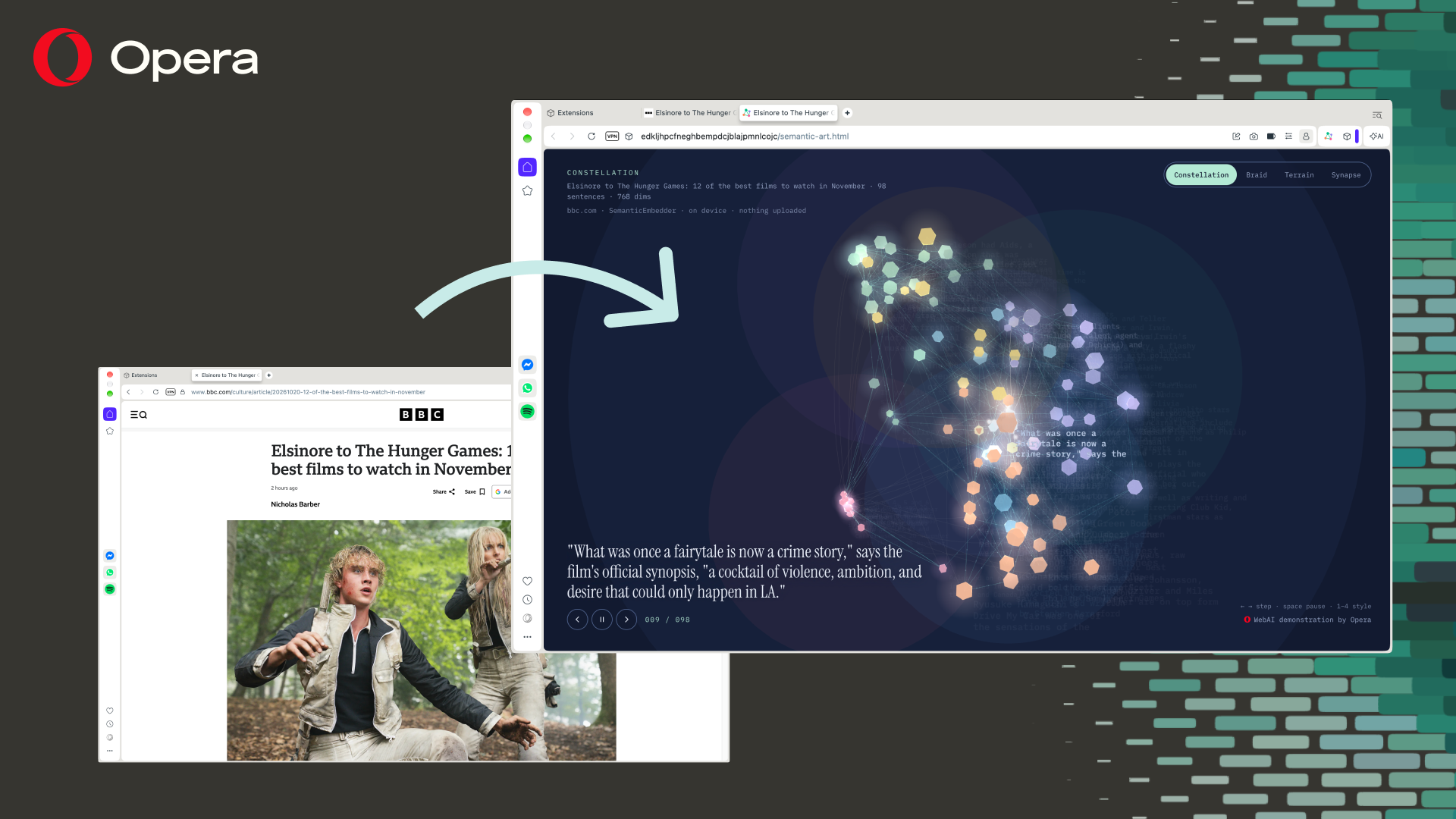
To show what developers can build, Opera is releasing example extensions, including one that turns an article into moving art, with similar sentences becoming visual neighbors. Learn more at next.opera.com/blog/web-ai-local-ai/.
Today’s launch is the start of a broader push. Opera plans to bring more open models optimized for different devices, along with more tools that make it easier to build browser experiences on local AI.
WebAI is available as an opt-in early preview on 64-bit Windows PCs (Intel or AMD) and Macs with Apple silicon. Because the AI runs on the user’s own device, performance depends on their hardware.
Also launching: HTML-in-Canvas
HTML-in-Canvas lets developers put real, interactive web pages inside 2D and 3D scenes. Menus, buttons and forms can move with the scene and still work, built with the HTML and CSS developers already know. That makes it a natural fit for games and Opera GX.
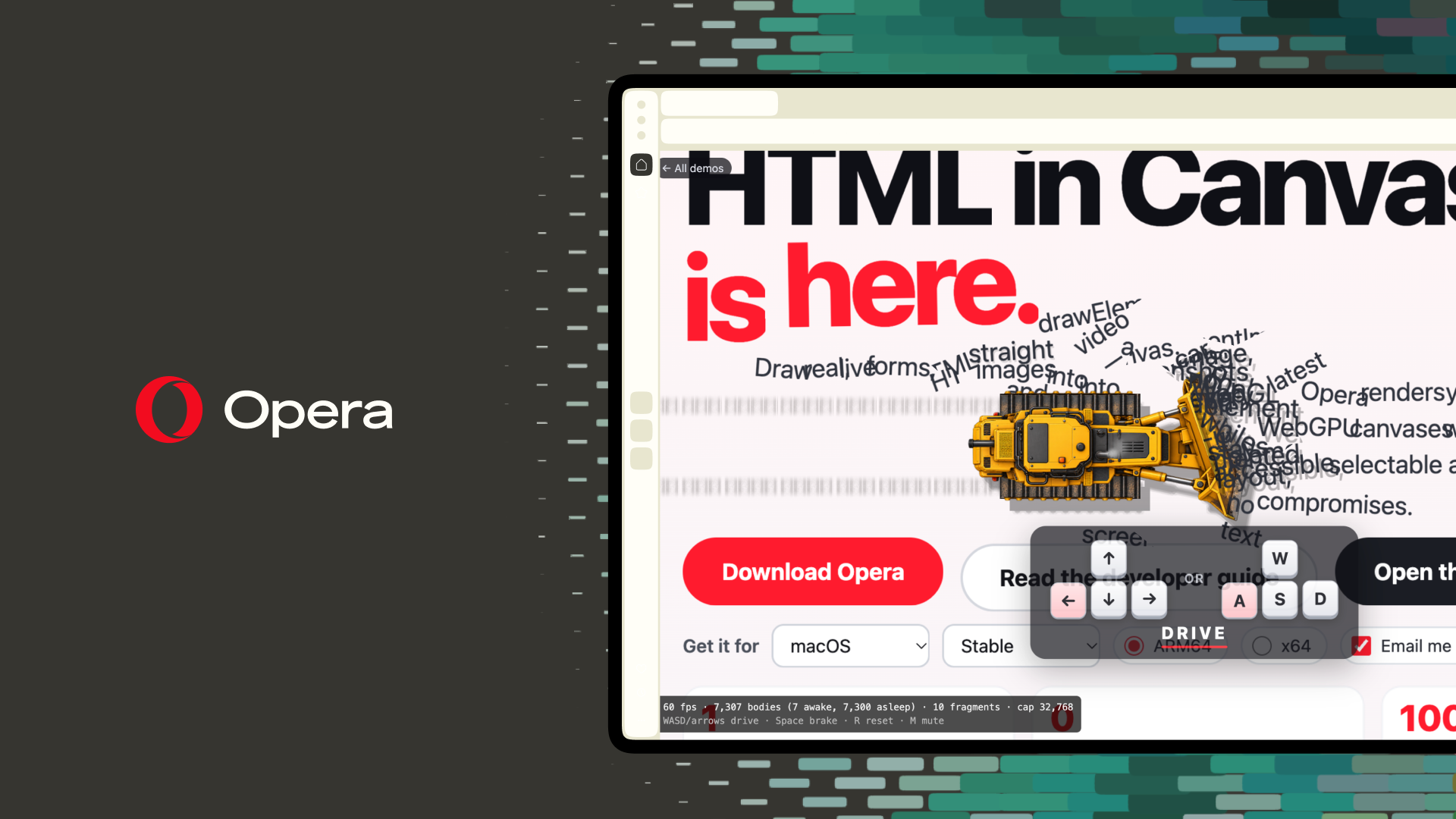
Opera’s demos include Webpage Bulldozer, where web page elements become physical objects, and Gamer Room, a 3D room with live web pages on its screens. Read more here next.opera.com/blog/html-in-canvas/.
“Honestly, this is a fun one,” said Maciej Kocemba, Product Director, Opera GX. “You can take a real web page and throw it into a 3D world, and everything still works: buttons, text, menus, all of it. We wanted users to get their hands on it early and see what they come up with.”
HTML-in-Canvas demos work in Opera browsers with no setup.
About Opera
Opera is a user-centric and innovative software company focused on enabling the best possible internet browsing experience across devices. Hundreds of millions of people use Opera browsers for their unique features on mobile phones and desktop computers. Founded in 1995 and headquartered in Oslo, Norway, Opera is publicly listed on the Nasdaq stock exchange under the ticker symbol OPRA. Download Opera browsers and other Opera products at opera.com. Learn more at investor.opera.com.